I Survived Home School, Back to School Graphics
As someone who’s launched over 200 digital product listings across Etsy, Creative Market, and Shopify—and built three profitable Canva template shops—I opened I Survived Home School, Back to School with clear intent: not just to admire it, but to assess its real-world commercial viability. My goal? To decide whether this graphic design asset earns a spot in my upcoming “Back-to-School 2024” bundle for print-on-demand sellers and Cricut crafters.
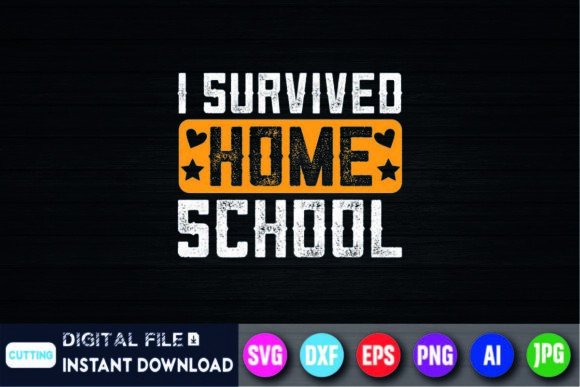
First impression: playful, slightly irreverent, and instantly relatable. The phrase carries nostalgic humor with a wink—ideal for parents who juggled algebra lessons at the kitchen table and teens proud of their homeschool resilience. Visually, it leans into bold, clean lettering with strong negative space, making it feel modern yet approachable. It’s not overly decorative or feminine, nor is it minimalist to the point of sterility. Instead, it lands in that sweet spot for small business branding: confident, conversational, and commercially flexible.
This isn’t just a t-shirt design—it’s a versatile digital product that scales across formats. I tested I Survived Home School, Back to School as an SVG design for Cricut projects (cutting accuracy was sharp on both vinyl and iron-on), converted it cleanly to PNG for sublimation mugs and tote bags, and dropped it into a Canva template pack as a ready-to-personalize greeting card layout. Its layered word structure means you can easily isolate “I Survived,” “Home School,” or “Back to School” for different use cases—great for creating sticker sheets, planner inserts, or social media graphics with visual hierarchy.
In practice, it shines brightest where personality meets practicality. Think: printable wall art for home offices, mug designs for teacher appreciation bundles, tumbler wraps for teen-focused craft fairs, nursery prints for homeschooling families, and even blog graphics for education-focused content creators. As a clipart-style illustration, it holds up well in themed bundles—paired with chalkboard textures, school supply icons, or graduation caps—to reinforce seasonal collections without needing custom illustrations from scratch.
For product presentation, I Survived Home School, Back to School delivers strong thumbnail appeal. Its high-contrast lettering pops on white mockups, and when reversed to light text on dark backgrounds (tested on navy and charcoal t-shirts), it retains legibility—especially important for Etsy product listings where scroll speed determines click-through. I used it across three mockup variations: a relaxed-fit crewneck, a ceramic mug with matte finish, and a digital planner cover. Each reinforced perceived value—not because the design is complex, but because it feels intentional, audience-aware, and professionally spaced.
Where does it work best? In large-format previews (think A4 printable posters), cohesive design bundles (e.g., “Homeschool Humor Pack”), and digital download listings where customers expect clean, layered files. It’s also ideal for social media promos—short-form Reels captions, Pinterest pins for back-to-school planners, and Instagram story templates for small business branding. On creative marketplaces, this kind of graphic design asset supports visual storytelling: it doesn’t just say “school”—it says “we made it through something real.” That builds customer trust faster than generic clipart ever could.
That said, use caution in certain contexts. Tiny sticker details? Skip—it’s not optimized for micro-cutting; fine serifs or tight kerning may not hold up below 1.5 inches. Avoid cramming it into text-heavy Canva templates where competing fonts dilute impact. And if your brand relies on ultra-premium aesthetics (e.g., serif-driven luxury stationery), this design’s casual energy might clash unless intentionally contrasted. Also verify cut quality before listing: some versions include subtle shadows or blended layers that don’t translate cleanly to Silhouette Studio or Cricut Design Space without flattening.
Here’s what I did before publishing a test listing:
- Previewed the SVG as a 60x60px Etsy thumbnail—no loss of clarity or emotional tone
- Test-printed the PNG on both white and heather grey fabric swatches to check color fidelity
- Confirmed full transparency on all PNG exports (no stray pixels or background bleed)
- Organized delivered files clearly: SVG (layered), PNG (300dpi, transparent), and a PDF usage guide for buyers
- Paired the design with four font families in mockups—sans serif for modern POD tees, script for greeting cards, handwritten for planner stickers, and bold display for social banners—to confirm visual flexibility
Crucially, I verified the commercial license covers finished goods—yes, it does. That means you can sell physical products like t-shirts, mugs, and tote bags using this graphic design asset, no attribution required. But remember: while the license permits resale, it doesn’t extend to reselling the SVG or PNG files themselves as standalone digital downloads unless explicitly permitted by the creator. Always double-check terms before bundling into your own design assets.
One underrated strength? Its adaptability to packaging design and brand identity systems. I dropped I Survived Home School, Back to School onto a kraft gift box mockup and paired it with a simple tagline (“Proudly Homeschooled Since 2020”)—instant cohesion for a handmade business launching a limited-edition collection. It also works in email headers, blog banners, and even podcast show notes graphics for education-focused creators building small business branding around authenticity.
If you’re curating a seasonal shop or building out a scalable digital product library, I Survived Home School, Back to School isn’t flashy—but it’s reliable. It converts well because it speaks directly to a niche with spending power: parents investing in curriculum, educators building classroom culture, and teens expressing identity. It’s not just another t-shirt design. It’s a conversation starter, a confidence marker, and a quietly strategic addition to any serious seller’s toolkit.